thriving
Thriving is a vital sense of wellbeing. Thriving in schools happens when students and adults can make choices to become their best selves. It inevitably means different things for different people.
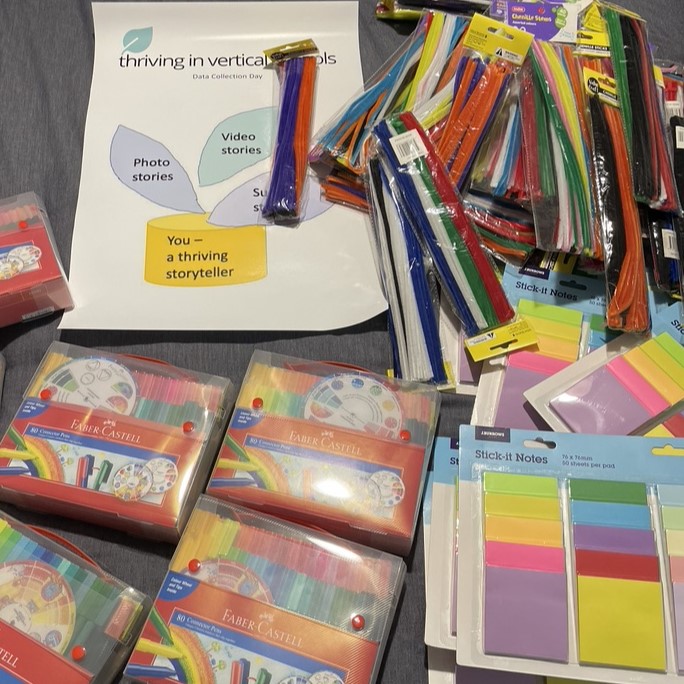
Explore the key ideas and the thinking behind them. These principles help explain why wellbeing is connected to spaces. They can also inform how vertical schools and all schools can be spaces for thriving.
Theory is a way of thinking and talking about familiar experiences in new ways. Theory can provide a shared language to talk about new ideas together. Different theories provide anchoring concepts that can invite new ways to frame the stories from data.
Thriving is a vital sense of wellbeing. Thriving in schools happens when students and adults can make choices to become their best selves. It inevitably means different things for different people.
Wellbeing is achieved when humans have the freedoms and opportunities to live a life they value. It is a sense of capability that is made possible by conversion factors within the environment. [1][2]
Capability is a student's opportunity to make meaningful choices. They have the freedom to make choices about the way they can 'be, do and feel' so that they can make choices to live a life they value, to have agency and be a 'well' being.
Salutogenic wellbeing describes how spaces can be 'health giving'. When you walk into a space and feel 'aaaaah' you may be experiencing a health giving space. It is a sense of coherence brought about when the space is manageable, meaningful and comprehensible. Professor Jill Franz created some principles for Salutogenic design [3] from the work of Antonovsky [4] that can be found in our 2024 publication.
The environment (including teachers) is a resource that helps me do what I want and need to do. It helps me cope by minimising stimuli and stress. I can manage my life as a student.
I feel motivated. My world makes sense.
The physical/social environment at school makes sense to me. There is transparency, consistency, constancy, predictability.
Verticality is the human experience of being, doing and feeling in a vertical school. This can include social experiences of connection and sustained close proximity.
Verticalness is the state of being vertical. It is made up of the physical elements of being a vertical school like stairs, an atrium, and views.
Student voice is where students are provided the space and opportunity to contribute meaningfully to matters affecting them in or related to school.
Paradoxes are the charged space between two truths where possibility can happen. The poles of a paradox are like the poles of a battery: hold them together, and they generate the energy of life; pull them apart and the current stops flowing.[5] Paradoxes are inherent in the everyday life of vertical schools.
journal article
Inclusion was uniquely conceptualised through capability and salutogenic theories. Inclusive environments were more evident when they were meaningful, made sense, and were easy to manage. Students highlighted the importance of choice, comfort, and spaces for resetting. Aspects where students had to work harder to manage the learning or themselves in the environment point to challenges in achieving SDG4a, where facilities need to be inclusive for all. The new conceptual approach extends current theory on designing for inclusion with intentionality in a holistic way to guide greater realisation of inclusive aspirations in school environments.
the conversation article
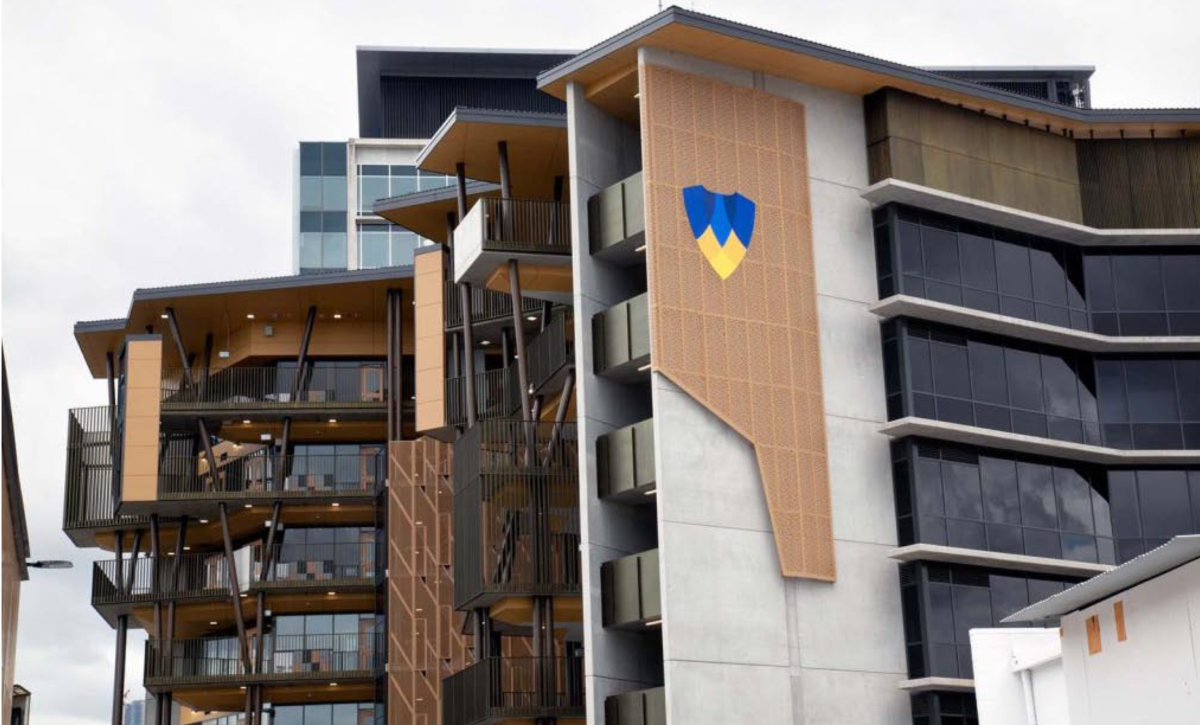
Vertical schools have an important role to play in the revitalisation of cities. They also are an invitation for city planners to think differently about the amenities and transport and facilities to support more young people and families in the city.
magazine article

The importance of student voice in designing and evaluating school spaces is explored in this short magazine article.
discussion paper
Written together with partners in the project, this discussion paper proposes questions worth investigating, to inform and extend evidence-based design and educational leadership in vertical schools. This document is based on a scoping review of literature to identify what conversations are already occurring about vertical schools. It found very little published peer reviewed literature specifically examining vertical schools, while media reporting was facilitating public awareness and raising a range of issues.
journal article
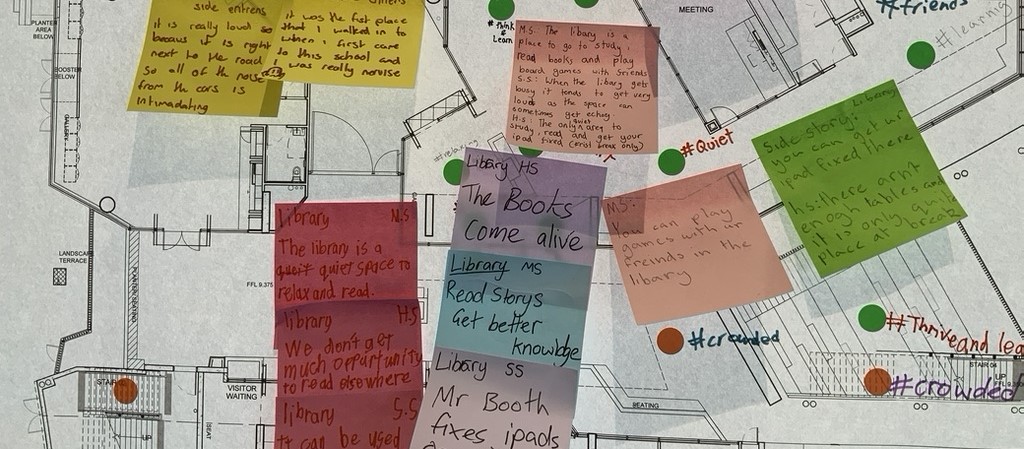
How can you gather stories from students in an inclusive way? This paper proposes it is by enabling students to share stories in multiple modes. The power of video is described and also some of the impact that stories had for our industry partners.
journal article
Student voice research recognises students’ roles as knowledge makers in cultural institutions like schools. Gathering rich qualitative data from large groups of students in schools using such participatory methods can be challenging, becoming methodologically “messy” for philosophical and practical reasons. This paper links high-level research principles and pragmatics of on-the-ground research strategy and improvisation to provide ways of managing the ‘mess’ of student voice research at scale.
journal article
Voices of young people are essential in civic discourse about thriving futures. Yet dialogue can be complicated when the experiences of adults and young people are vastly different, for example in school spaces designed by adults in cities designed for adults. Vertical, highrise inner city schools represent this intersection. A new genre of school in Australia, vertical schools symbolise aspirations for young people and livable cities as designed by adults. This paper draws from data collected in the Thriving in Vertical Schools project to explore the importance of affective learning atmospheres for students, and the value of digital stories to prompt dialogue between young people and adults. 204 secondary students created 96 one-minute digital stories about what it takes to thrive in vertical schools. A close analysis of 4 representative videos shows how students communicated a wide range of affective, embodied experiences and used the friction inherent within digital narratives to highlight issues of importance, which promoted dialogue with adults in audio-recorded screening discussions. The power of digital stories to mediate civic discourse with adults, and new insights like the importance of unscripted, edge spaces as spaces for young people to learn to thrive, have implications for thriving schools and cities.
This chapter suggests that design patterns are a valuable way to share complex design knowledge about student-school interactions. It builds on prior work suggesting that design patterns, in a pattern language, are able to cross disciplinary boundaries and do work for design and education practitioners. It applies design patterns in an example of salutogenic (health promoting) design of vertical schools where research needed translating into actionable knowledge. The chapter provides a case study in initiating a pattern language, a set of design patterns, following a three-year participatory study of students in vertical schools in an Australian context. It describes the process of creating the patterns, their utility, the theory behind their efficacy, and the proposed value of design patterns more broadly within human-building interaction (HBI). It contributes a set of five design patterns for salutogenic student-school interactions.
journal article
Urban vertical schools in Australia represent a novel approach to education, necessitating a reimagining of traditional school designs to accommodate growing urban populations and innovative pedagogical practices. This study reveals how aspirations guided the design of three vertical secondary schools, highlighting a collective narrative of "doing things differently" that emphasizes collaboration, creativity, and adaptability in educational environments.
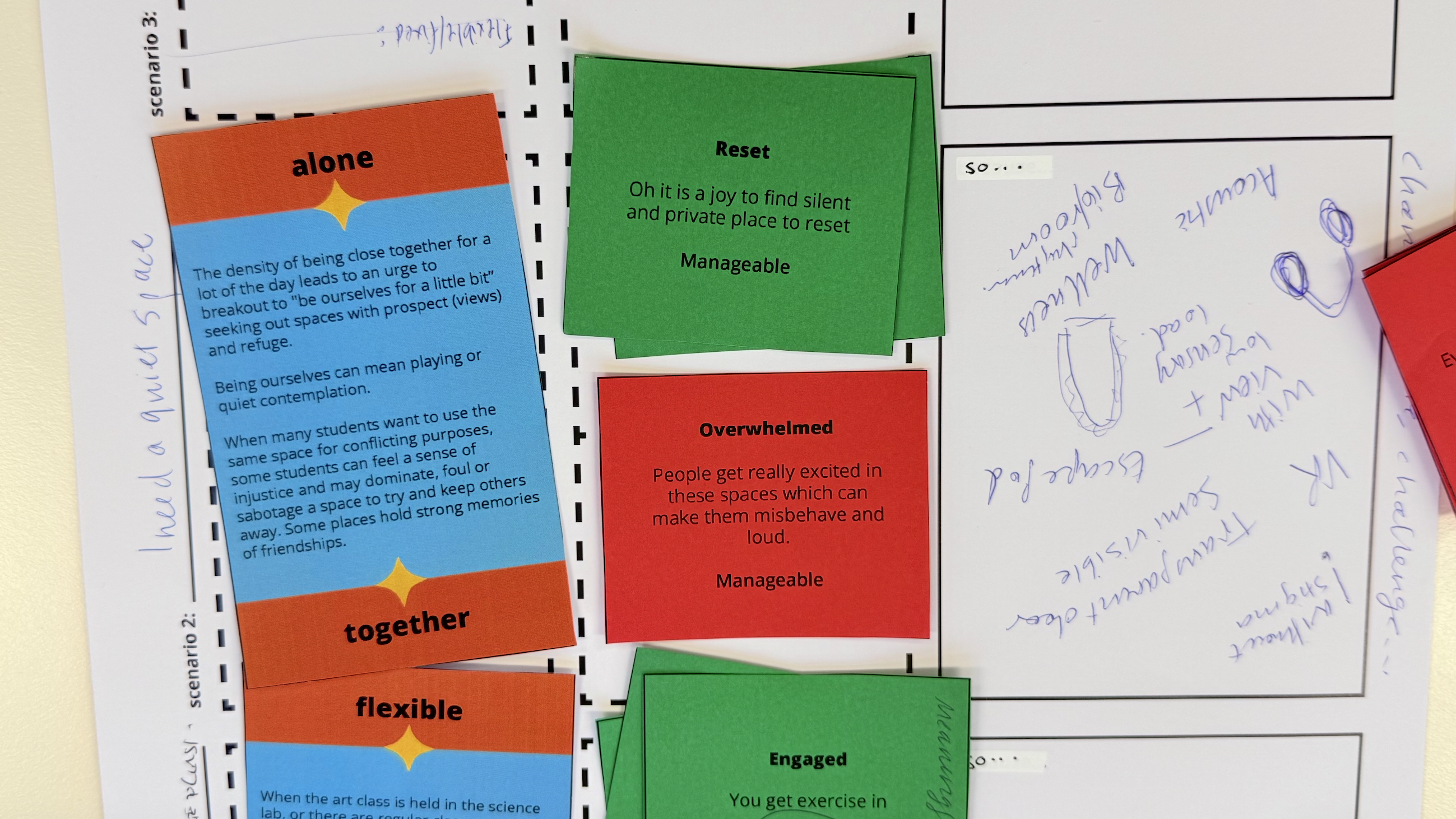
The small footprint of a vertical school introduces paradoxes. We have created a playful way to learn about and explore what it means to live with seven of these paradoxes, intended for architects, designers, educators, and school leaders.
play with paradoxJoin us for forums, presentations, and events where we dive into our latest research findings and innovative ideas. Stay connected with our past and upcoming events to explore impactful discussions, and don't worry if you miss one — recordings are often available after the live sessions so you can catch up anytime.
conference workshop
This session introduces our playful Paradoxes & Thriving: a collaborative activity designed to help participants explore and imagine what it is like to learn, teach, and work within vertical schools. Through scenarios and student perspectives, designers, architects, school leaders, and teachers can work together to unpack the lived complexities of these environments.
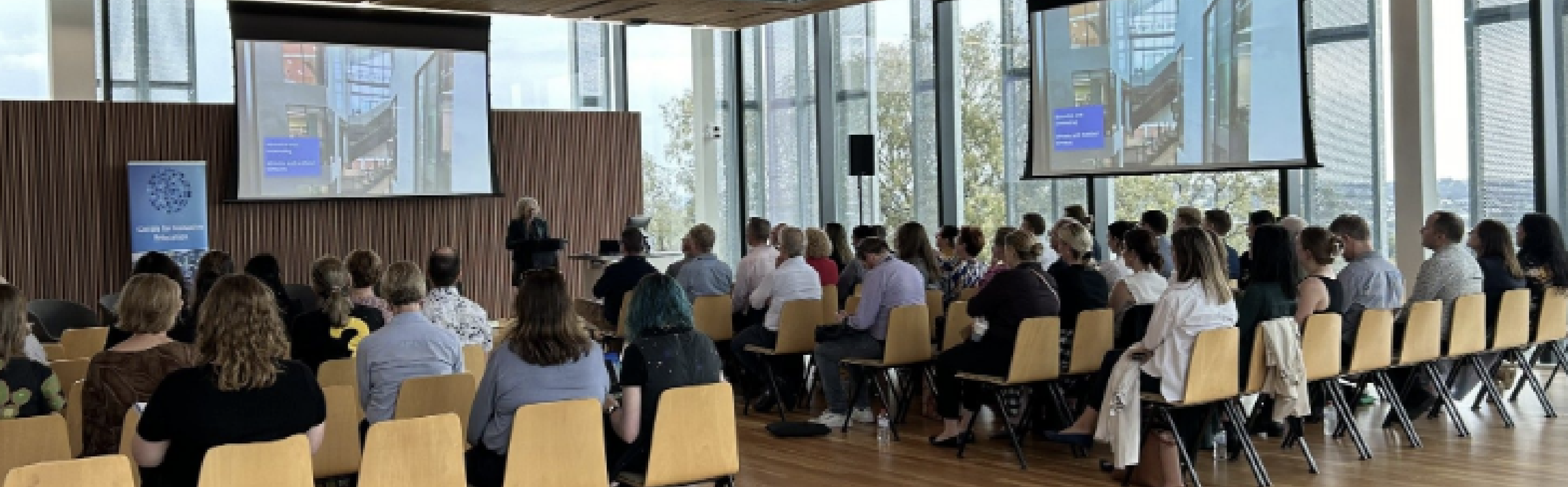
How can Thriving in Vertical Schools shed light on student learning and wellbeing for all schools? Access the recording to hear from students, partners, and researchers about the stories that have emerged over the course of the project. Learn how these stories shaped the thinking moving forward around space, people, objects, curriculum, and design.
conference workshop
This workshop demonstrated how the amplification effects of vertical schools bring light to wellbeing possibilities for the future of all school design. Salutogenic, pro-active principles for inclusion and wellbeing and inclusive student voice methods for post-occupancy evaluation will be modelled as attendees interact with student produced video data.
This induction video is designed to support teachers, school leaders, and staff who are new to working in vertical schools. Drawing on research with students, educators, designers, and school communities, the video explores the everyday realities of learning and teaching in dense, multi-storey school environments.
Whether you are joining a vertical school for the first time or are curious about what it's like to live, work, and learn in one, this resource offers an introduction to the unique rhythms, challenges, and opportunities that shape everyday life in these environments.
Sen, A. (2005). Human rights and capabilities. Journal of Human Development, 6(2), 151-166. https://doi.org/10.1080/14649880500120491
Nussbaum, M. C. (2006). Education and democratic citizenship: Capabilities and quality education. Journal of Human Development, 7(3), 385-395. https://doi.org/10.1080/02671520600942438
Franz, J. (2019). Designing 'space' for student wellbeing as flourishing. In H. Hughes, J. Franz, & J. Franz (Eds.), School spaces for student wellbeing and learning (pp. 261-279). Springer.
Antonovsky, A. (1996). The salutogenic model as a theory to guide health promotion. Health promotion international, 11(1), 11-18. https://doi.org/10.1093/heapro/11.1.11
Palmer, P. J. (2017). The courage to teach: Exploring the inner landscape of a teacher's life. John Wiley & Sons.